Swimming Against the Tide: The Story Behind Britain's Restaurant Fish Tanks
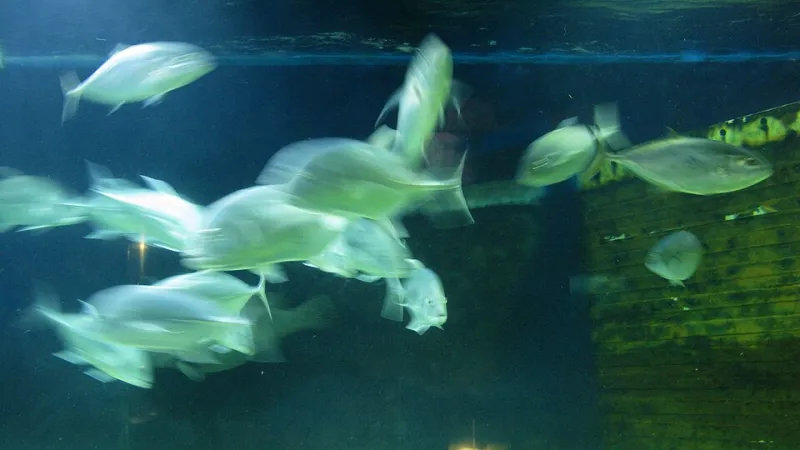
Photo: Vyacheslav Argenberg, CC BY 4.0, via Wikimedia Commons
You know the scene before you know you know it. The window, half-curtained, half-lit. A laminated menu in a plastic stand. And there, beside the door, a tank: blue gravel, a plastic frond, a castle that has seen things, and one fish — usually gold, usually enormous, usually regarding you with the flat contempt of a creature that has never had to pay a bill.
We tend not to think about it much. It's just there, like the paper napkins. But a fish tank in the window of a Chinese restaurant is one of the most quietly deliberate pieces of design on the British high street, and it carries more meaning per litre than almost anything else in the room.
First, the Water
Start with the most practical layer. In Chinese spatial tradition — the loose, household-level version of feng shui that most families actually use — water is associated with the gathering and movement of wealth. Stagnant water is a problem; moving, aerated, filtered water is not. A tank by the entrance is doing, in a modest way, the job a fountain does in grander buildings: keeping something alive and in motion at the threshold.
This is also why so many of the tanks you've walked past bubble and burble. That hum isn't sloppiness. A pond that doesn't move is a pond that dies.
There's a softer explanation too, and it's probably the truer one. Water settles a room. The sound of it, the low glow of it, takes the edge off a doorway that is otherwise a corridor between a cold street and a warm dining room.
The Pun Hiding in the Glass
Here's where the tank earns its keep as storytelling. In Chinese, yú — fish — is a homophone of yú meaning surplus, abundance, something left over. The old phrase nián nián yǒu yú — every year, surplus — is one of the most familiar good wishes in the language. A fish in the window is, quite literally, a blessing written in a language most passers-by can't read but can still feel.
This is why goldfish (jīn yú, the golden fish) turn up so often, and why the arowana — the long, ancient-looking dragon fish — is prized by those who can afford the electricity bill it demands. Certain numbers of fish get chosen deliberately; odd numbers; particular colours. Some households keep a dark-coloured fish among the gold ones. Some don't. Ask three families and you'll get three systems, which is exactly how folk tradition works.
From a Courtyard Vat to a Window Cabinet
The fish tank didn't arrive from nowhere. Keeping fish in ceramic vessels goes back centuries in China — the courtyard vat, the stoneware basin by the wall of a scholar's garden, the goldfish that were bred for colour long before anyone in Europe thought of them as pets. The scholar's studio, with its plants and its basin of water, was a small attempt to hold a bit of landscape indoors.
So when families from Hong Kong and the New Territories opened restaurants across Britain from the 1950s onwards — and then in far greater numbers through the 1970s and 1980s — they brought a piece of domestic ritual with them. The courtyard vat became a glass cabinet with a fluorescent tube. The principle survived the transplant.
Is It Dinner or Decoration?
There's a persistent assumption that every tank in a Chinese restaurant is a larder. Sometimes it is. Many places, especially in Chinatown and along the big-city seafood corridors, run holding tanks for crab, lobster, eel and shellfish — and there the aerator's rattle is a freshness cue, plain and simple. You can point at your dinner.
The ornamental tank is a different animal, so to speak, and it's worth separating them, because conflating the two is where a lot of lazy assumptions begin. The one by the door with the plastic castle is not a menu. It's hospitality.
The Labour Nobody Photographs
Anyone who has kept fish knows what that tank actually costs. Water changes. Filter media. Algae scraped off glass on a Tuesday morning before service. The 2am panic when the power trips and the pump stops. Somebody in that restaurant is on a rota, and it isn't a glamorous rota.
That's the part I find genuinely moving. A tank is an ongoing, unglamorous expense undertaken so that a stranger walking in off a wet British evening has something alive to look at while they wait for a table. It's a handshake made of water and electricity.
Why They're Going Quiet
And yet. Look at refits from the last decade or so and the tank is often the first casualty. There are sound reasons. Maintenance is a fixed cost in an industry where nothing is fixed. Refurbishments now chase a certain kind of photograph-friendly minimalism — pale wood, rattan, a wall of neon script — and a bubbling tank fights that look rather than serving it. Delivery-first economics mean fewer people sitting in the window at all, so the theatre has less of an audience. Add in tighter rules and growing sensitivity around animal welfare in commercial spaces, and you have a strong argument for a plant.
None of this is decline, exactly. British Chinese food is changing shape rather than shrinking — the old high-street vernacular giving way to something faster, slicker, more regionally specific.
What Goes Out With the Tank
But something does leave with it. A tank made a restaurant into a small aquarium of patience: you couldn't rush a meal while a fish was circling. It gave children something to kneel in front of. It gave solo diners something to look at that wasn't a phone. It hid the swing door to the kitchen and softened the light on the chipped end of the counter.
Most of all, it was a living thing in a room built for transactions. That's rare, and it's worth noticing while it's still there.
So next time you're waiting for a table, and the tank is humming away in the corner, give the big gold one a nod. It has been greeting people in this country for longer than most of us have been eating here.