A Noodle for Luck, a Cake for Candles: Building a British Chinese Birthday Table
British birthdays arrive with a certain choreography. There is a cake, usually a Victoria sponge or something wearing a plastic caterpillar, candles that refuse to light, and a chorus of ‘Happy Birthday’ that starts too high. A Chinese birthday, by contrast, arrives with a bowl of noodles. Not any noodles — long-life noodles, shou mian, strands that are meant to be as long as possible and, crucially, left uncut. Put the two on the same table and you have a small cultural negotiation. The good news: it is a negotiation that ends in cake.
The Noodle That Refuses to Be Cut
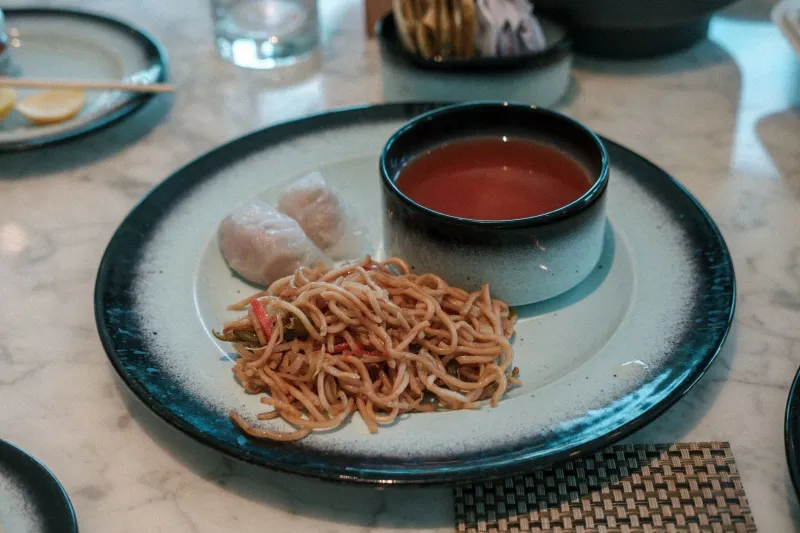
Long-life noodles are not a gimmick. In Chinese households, a bowl of shou mian at a birthday is a wish made edible: the longer the strand, the longer the life. The noodles are often served in a simple broth, sometimes with egg, spring onion, or a little pork, and the etiquette is straightforward but firm. Do not cut them. Do not bite through them if you can help it. Lift, slurp, and let the strand run its full length. Slurping is not rude here; it is the point. A knife at a birthday table is about as welcome as a parking ticket.
This is where British habits can trip you up. We are a nation of cutlery pragmatists. Give us a long noodle and we will reach for a knife and fork, then chop it into manageable lengths before it flicks broth down a shirt. In a Chinese home, that is the equivalent of blowing out someone’s candles before they have made a wish. If you are a guest, use chopsticks or a spoon, and if a strand is truly unwieldy, lift it high and let gravity do the work. If you are hosting, serve the noodles in a deep bowl with a spoon alongside the chopsticks. Make it easy to do the right thing.
The Cake That Asks for Candles
The Victoria sponge has its own quiet claim on the British birthday. It is not flashy. It is jam, cream, and two layers of sponge, ideally eaten at a kitchen table with a pot of tea. Its birthday role is not symbolic in the same way as the noodle — it is theatrical. Candles, a wish, a puff of breath, applause. The cake is less about longevity and more about the moment. That is why the two work so well together: one is a wish for years, the other is a wish for now.
There is no rule that says a Chinese birthday table cannot include a cake. In Hong Kong, Malaysia, and Singapore, Western-style birthday cakes are entirely normal at Chinese celebrations. In Britain, the reverse is increasingly true: families with Chinese heritage order a takeaway feast and then bring out a supermarket cake with candles. The traditions are not rivals. They are colleagues.
Setting the Table: Restaurant, Takeaway, or Your Own Kitchen
If you are booking a Chinese restaurant for a birthday, ring ahead. Ask whether they can serve a bowl of plain long-life noodles as part of the meal. Many will, even if it is not printed on the menu. If they only have noodle dishes with vegetables or meat, ask for the noodles to be left uncut. Explain that it is for a birthday. Restaurant kitchens understand this; they may even bring the bowl out with a quiet smile.
The cake is the next question. Some restaurants will happily store a cake in the fridge and bring it out with the lights dimmed. Others will charge a small cutting fee or ask you to take it home. Ask when you book. Do not assume. If you are ordering a takeaway, the logistics are simpler: collect or have delivered a feast, cook a separate pot of noodles at home, and keep the cake in the fridge until the savoury food is done. The takeaway does the heavy lifting; you do the symbolism.
At home, the order of play matters. Serve the noodles as part of the main meal, not as a starter. Let everyone take a strand before the plates are cleared. Then clear the table, make tea, and bring out the cake. The noodles are the blessing; the cake is the party. Nobody needs to choose.
The Etiquette Nobody Explains
There are a few small things that make a mixed table run smoothly. First, do not serve noodles that have been cut in the kitchen. If you are cooking, keep the strands long. Second, do not ask for a knife to cut them at the table. Third, if you are a guest and you are unsure, watch the person who knows. They will lift their noodles high and slurp. Follow suit.
One more thing: the birthday person should be served first. In Chinese tradition, the bowl of noodles goes to the person whose birthday it is, and they take the first strand. In British tradition, the cake goes to the birthday person after the candles are blown out. Both traditions agree on the important part: the day belongs to them.
Two Traditions, One Wish
A birthday table with a bowl of long-life noodles and a Victoria sponge is not a compromise. It is an upgrade. The noodle says: may you have many more years. The cake says: and may this one be happy. At Shuxiang Ge, we like a table that can hold both. Order the feast, boil the noodles, light the candles, and let the strands run long.