The Bright Yellow Argument: Giving Takeaway Curry Sauce Its Due
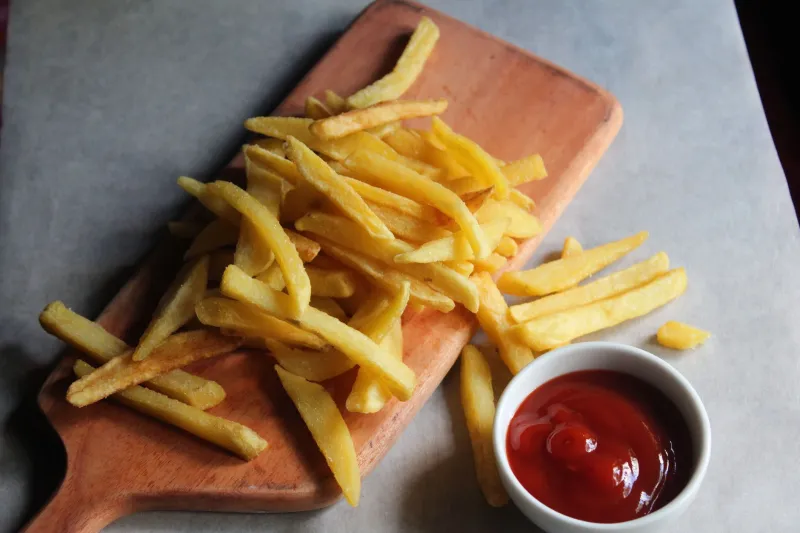
There is a particular shade of yellow that belongs almost exclusively to the British Chinese takeaway. It is not the yellow of lemon curd or mustard. It is closer to the colour of a hazard sign that has decided to be friendly. It turns up in a small plastic tub, often beside a bag of chips, and it divides people with a force that seems out of all proportion to its price.
Some customers would not order a Chinese without it. Others treat it as evidence that the whole cuisine has gone off the rails. The curry sauce conundrum is not really about sauce at all. It is about what we expect Chinese food in Britain to be, and what happens when a menu quietly admits that it has been shaped by the country it lives in.
A sauce with no single parent
Let us start with the obvious: this is not an ancient Chinese recipe. It is a British Chinese invention, or more accurately a British Chinese adaptation. The bright yellow curry sauce served at takeaways sits in the same family as chips with curry sauce from the fish and chip shop, but it is not the same thing. The Chinese takeaway version is usually glossier, smoother and more savoury, with a mild heat and a faint sweetness underneath.
Its rise makes sense. In the decades after the Second World War, Chinese restaurants and takeaways in Britain had to cook for a local market. Curry powder was already a familiar cupboard ingredient. A sauce built on curry powder, turmeric, stock and a little cornflour could be made quickly, stretched across many orders and used to moisten rice, chips or whatever else came out of the fryer. It was practical. It was cheap. It was warm. And it was familiar enough to reassure customers who were not yet ready to order something they could not pronounce.
That does not make it inauthentic. It makes it honest. British Chinese food has always been a conversation between kitchens and customers, and curry sauce is one of the clearest places where that conversation is written down.
What is actually in the tub?
Preparation varies enormously. Some takeaways use a commercial powder or paste, which is why the sauce can taste thin and floury in the wrong hands. Others make it from scratch with onion, garlic, curry powder, turmeric, stock and cornflour. The best versions have a rounded savoury depth, a gentle spice and a texture that coats a chip without clinging to it like wallpaper paste.
The colour comes mostly from turmeric. The body comes from cornflour or a similar thickener. The flavour should come from toasted spices and a decent stock, not from raw powder. When it is good, it tastes like a comfortable compromise: not a curry house sauce, not a Chinese gravy, but something in between that knows exactly what job it is doing. When it is bad, it tastes of nothing but yellow.
That range is part of the problem. A single disappointing tub can convince a whole table that the sauce is a joke. But judging the whole tradition by the worst version is like judging British bread by a supermarket white loaf.
The regional accents
Travel a few miles in the UK and the sauce changes. In some places it is thin and pours easily. In others it is thick enough to stand a spoon in. Some takeaways add visible onion; some blend everything to a shine. In parts of Scotland, curry sauce with chips is close to a default order. Elsewhere it is more of a side attraction, something you add if you are feeling adventurous or hungry.
This is not a national dish with a rulebook. It is a local dialect. A takeaway in one town may make a sauce that is sweeter and milder, while another a few streets away goes heavier on the spice. Customers build loyalty around these differences without ever calling them differences. They just know that their local does it right and the place across town does it wrong.
That is how food cultures actually work. They are not preserved in glass cases. They are argued over at counters, adjusted for regulars and passed down through kitchens that rarely write anything down.
Why it provokes such strong opinions
Curry sauce is a useful Rorschach test. For some, it is comfort in a tub: the thing you dip chips into after a long week, the sauce that makes a plain bag of food feel like a treat. For others, it is a symbol of everything they dislike about British Chinese food: the deep-fried, the sweetened, the brightly coloured, the not-quite-Chinese.
But the criticism often misses what the sauce is for. It is not trying to be a Cantonese classic. It is trying to make a meal work. It moistens. It seasons. It adds a little heat and a lot of colour. It turns a dry bag of chips into something you can eat with a fork. In a takeaway, that is not a small thing.
The sauce also exposes a quiet anxiety about authenticity. British diners happily accept chicken balls, pineapple fritters and chips on a Chinese menu, but curry sauce is the item that gets called out. Perhaps because it is so visible. Perhaps because it admits the hybridity that the rest of the menu can sometimes hide. The bright yellow tub is a seam, and some people would rather not see the stitching.
The scholar's view
At Shuxiang Ge, we like to think of a menu as a text. It has a history, a grammar and a set of assumptions about the reader. Curry sauce is not the main sentence. It is the footnote, the margin note, the gloss in the corner. And footnotes are often where the most interesting admissions live.
The sauce tells us that British Chinese identity is not a fixed thing. It is a process. It is a kitchen in Glasgow or Manchester or London looking at its customers and deciding what will work. It is a cook taking an ingredient from one tradition and a habit from another and making something that belongs to neither and both. That is not a failure of authenticity. It is what food does when people move.
How to order it well
If you are curry-sauce curious, start with a small tub on the side rather than a full portion poured over everything. Try it with chips first. That is its natural habitat. Then try it with plain rice or a few noodles. A good sauce will taste savoury and gently spiced, not just sweet or floury. If your local makes it in-house, ask. Some do. If they do, order it with a little more confidence.
The yellow tub will remain divisive. It is too bright, too cheap and too closely tied to the British Chinese takeaway to ever be fashionable. But it deserves better than a shrug. Next time it arrives beside your chips, do not push it to the edge of the table. Treat it as a small, strange, entirely logical part of the story. It is a footnote worth reading.