Smoke, Steel and Sunday: A Beginner's Confession About My First Proper Wok
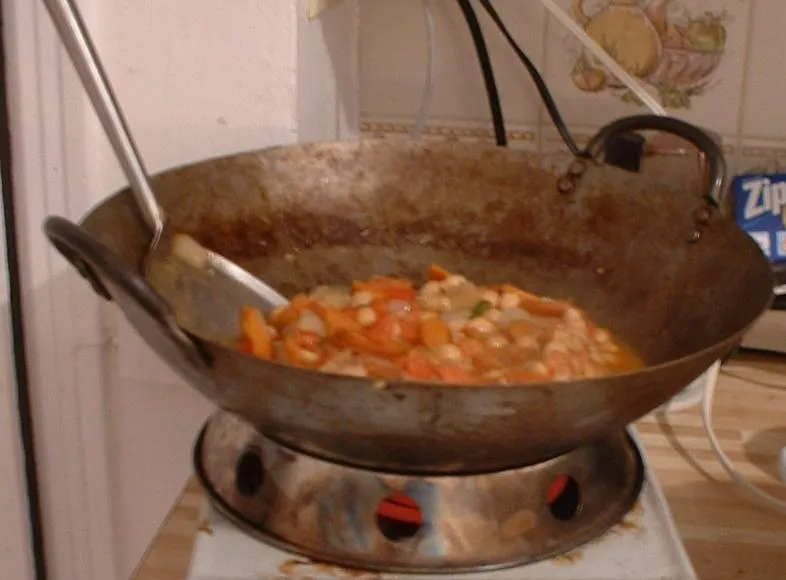
Photo: User Aarchiba on en.wikipedia, Public domain, via Wikimedia Commons
For years I thought the problem was my kitchen. Every stir-fry I attempted came out steamed rather than seared — pale strips of chicken swimming in a lukewarm puddle of sauce, the pak choi grey and apologetic. I blamed the electric hob in my rented Manchester flat. I blamed the extractor fan, which sounded like a hairdryer with a grievance. It took a long conversation with a chef friend from a Cantonese restaurant in Chinatown to make me face the truth: the problem was the pan.
Or rather, the absence of one. I'd been using a non-stick frying pan and calling it a wok. It's a bit like calling a kettle a samovar. Technically it holds liquid, but the soul isn't there.
Why Non-Stick Fails the Test
Here's the thing about non-stick coatings: they can't take the heat. A proper stir-fry wants the pan surface at around 200°C or more before the oil goes anywhere near it — that's how you get wok hei, the smoky, almost burnt breath of the wok that chefs describe as the mark of real skill. Non-stick coatings start to degrade at high temperatures, which is why your non-stick pan will never give you that flavour, no matter how much you wish it would.
Carbon steel, on the other hand, doesn't just survive high heat — it thrives on it. And like a cast iron pan, a carbon steel wok develops a seasoned surface over time: layers of polymerised oil baked into the metal that make it naturally slick, dark and increasingly non-stick the more you cook with it. It's the opposite of a disposable coating. It's a pan that improves with age, like a good cast iron skillet or, say, a well-loved Le Creuset.
The catch? You have to earn it. A brand-new carbon steel wok arrives coated in a protective layer of machine oil and looks like something from a hardware shop. You cannot cook on it until you've seasoned it. Skip that step and your first stir-fry will taste of metal and regret.
Buying Your First Wok in the UK
You don't need to spend a fortune. A 35cm (14-inch) flat-bottomed carbon steel wok with a wooden or steel handle will set you back £15–£30 from any Chinese supermarket, Asian grocer or, increasingly, mainstream retailers like John Lewis and Lakeland. Here's what to look for:
- Flat bottom, not round. Unless you've got a proper wok burner, a flat base sits better on a British hob — gas or induction.
- Carbon steel, not stainless steel or cast iron. Carbon steel heats fast, responds quickly and seasons beautifully.
- A long handle and a helper handle if you can get one. You'll be tossing ingredients with one hand and grabbing the pan with the other.
- No non-stick coating. Obviously.
If you're near a Chinatown — Manchester, Birmingham, London, Newcastle, Glasgow all have good options — the staff will usually point you to the right one if you tell them you're a beginner. Don't be embarrassed. Everyone starts somewhere.
The First Seasoning: A Step-by-Step Guide
This is the part that puts people off, but honestly, it's less complicated than a Sunday roast. You'll need: your new wok, washing-up liquid, a scourer, a neutral high-smoke-point oil (groundnut or rapeseed — both cheap and available at any supermarket), and some kitchen paper.
- Scrub it. Hot soapy water and a scourer. You're removing the factory oil. This is the only time you'll ever use soap on your wok, so enjoy it.
- Dry it thoroughly and put it on the hob over a medium heat until it's completely dry — any residual water will cause rust.
- Heat it until it changes colour. Turn the heat up and watch the metal. It'll start to blush — blue-grey, then darker patches. This is the oil burning off and the metal opening its pores. Don't panic. Don't touch it.
- Add the oil. Turn the heat down to medium-low. Add a teaspoon of oil and, using tongs and a folded wad of kitchen paper, wipe it around the entire inside surface of the wok, right up the sides. It'll smoke. That's fine — that's the polymerisation happening.
- Repeat. Keep wiping thin layers of oil into the hot metal for about ten to fifteen minutes, until the inside has an even, dark, slightly glossy sheen. Thin layers are key — a thick slathering of oil will go sticky and patchy.
- Cool it, wipe it, store it. Once cool, wipe out any excess oil with a clean cloth. Done. Your wok is now seasoned and ready.
A word of warning: open a window, switch on the extractor, and maybe relocate the smoke alarm temporarily. The first seasoning is a smoky business. My neighbours in Manchester thought I'd set fire to the building. I apologised with dumplings, which I'd cooked in my new wok, so everyone won.
Living With Your Wok: The Daily Habits
Once seasoned, the maintenance is almost embarrassingly simple. Cook with it, then rinse it with hot water (no soap — ever), scrub gently with a soft brush if needed, dry it on the hob over a low heat for thirty seconds, and wipe a tiny smear of oil over the surface with kitchen paper before putting it away. That's it. Thirty seconds of care after every use.
If it ever looks dull or patchy, don't despair — just repeat a shortened version of the seasoning process. If it rusts (it happens, especially in damp British kitchens), scrub the rust off with steel wool, wash, dry, and re-season. Carbon steel is forgiving like that. It wants to be used.
The Mistakes I Made So You Don't Have To
My chef friend, who asked not to be named but who has been cooking in Chinese kitchens for twenty years, laughed at me for three separate things:
- I used too much oil at first, thinking a seasoned wok needed it. It doesn't. Once seasoned, you need surprisingly little — a tablespoon or less for most stir-fries.
- I crowded the pan. The single most common beginner error, apparently. If you put too much in at once, the temperature drops, everything releases water, and you're back to steaming. Cook in batches. Yes, it's annoying. Do it anyway.
- I didn't let the pan get hot enough before adding ingredients. The pan should be smoking slightly before the oil goes in, and the oil should shimmer before anything else. Patience is a wok skill, apparently.
Is It Worth It?
Genuinely, yes. My stir-fries now have that charred, savoury edge I'd been chasing for years. Vegetables stay crisp and vivid. Fried rice actually tastes like fried rice instead of warm rice with things in it. And there's something quietly satisfying about owning a pan that gets better every time you cook, rather than one that's slowly degrading in a drawer.
A wok isn't a gadget. It's a relationship. It asks for a bit of patience at the start and thirty seconds of care afterwards, and in return it'll outlast your tenancy, your hob, and possibly your kitchen. That's more than I can say for any non-stick pan I've ever owned.
Get the wok. Do the seasoning. Open a window first.