Rice, Water and Recovery: The Case for Congee on Sick Days
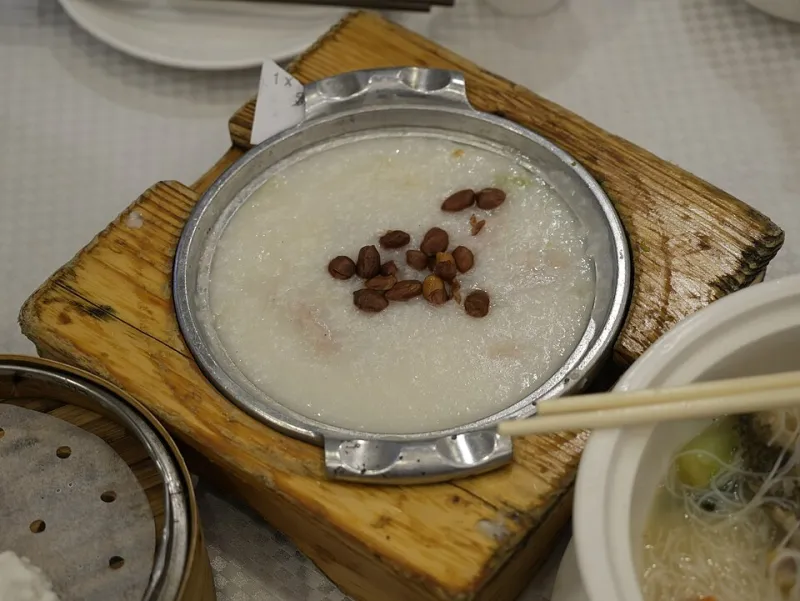
Photo: Peachyeung316, CC BY-SA 4.0, via Wikimedia Commons
There's a peculiar moment in every British illness. You've survived the first day of the cold — the shivering, the doom-scrolling, the Lemsip — and now you're hungry, but not hungry hungry. You want food that forgives you. Food that doesn't ask anything of your body.
For most of us, that means toast. Or beans. Or, if a kindly relative has intervened, a vat of chicken soup. But across China — and indeed most of Asia — there's only one answer, and it's been the correct answer for over a thousand years: congee.
What Exactly Is This Stuff?
Congee is rice porridge. That's it. Rice simmered in a generous excess of water until the grains surrender completely and the whole pot turns into something between a soup and a soft blanket. It sounds like nothing. It tastes like possibility.
The beauty is in the blandness. When your throat feels like gravel and your stomach has filed a formal complaint, congee is the food equivalent of a duvet. Warm, soft, faintly sweet, requiring approximately zero chewing. It's the kind of dish you could eat with a sore throat, a broken heart, or a hangover that started on Tuesday.
The Scholar's Sickness Food
Here's where it gets properly on-brand for a place called Shuxiang Ge. Congee has a long association with China's literati — the scholars who spent years cramming for the imperial civil service exams. Rice porridge was cheap, filling, and easy on the digestion, which mattered when you were studying by lamplight and eating on a budget.
There's even a line in the Zhou Li, one of the Confucian classics, describing congee as a food for the sick and the elderly. Scholars wrote about it. Poets praised it. One Qing dynasty food writer, Yuan Mei, devoted serious ink to getting the ratio of rice to water right — his verdict was that a good congee should have no visible grain and no visible liquid. It should, in his words, become one thing.
So when you're off work with a cold, you're in venerable company. The sick and the studious have always known: rice, water, patience.
The British Invalid Food Problem
Let's be honest about our own traditions. The BRAT diet — bananas, rice, applesauce, toast — is basically congee's sad cousin, the one who never got the recipe. Chicken soup is genuinely lovely, but it demands effort from a person who currently considers walking to the kettle an achievement.
Congee, meanwhile, is almost entirely hands-off. And crucially, you can make it with things you already own:
- Rice. Any long-grain or jasmine rice from the cupboard. Nobody's judging.
- Water or stock. A stock cube counts. This is a judgement-free zone.
- Salt. Non-negotiable, but minimal.
The ratio is roughly 1 part rice to 8 parts water. Bring it to the boil, drop it to the lowest heat your hob allows, and stir occasionally for 45 minutes to an hour. That's the whole job. If you have a rice cooker, most of them have a porridge setting, which means dinner can be made while horizontal.
Dressing Up the Blanket
Plain congee is medicine. Dressed-up congee is dinner. The toppings are where it gets fun, and — this is the point — they're all supermarket territory:
- Century egg and pork is the classic, but let's not start there. Instead: a fried egg with crispy, lacy edges, dropped straight on top.
- Leftover roast chicken, shredded, with a splash of sesame oil. Sunday's leftovers, Monday's comfort.
- Spring onions and soy sauce. The absolute minimum viable congee, and genuinely brilliant.
- Crispy shallots or fried onions from the jar — the same ones you put on a banger casserole. No one will know.
- A spoonful of chilli crisp if your sinuses need clearing. This is medicinal, arguably.
The congee is the canvas; the fridge is the paint. Even at your most pathetic, you can manage a soft-boiled egg and some soy sauce, and that's a proper bowl.
Make It Your Sick-Day Ritual
There's a version of British convalescence that involves Lucozade and daytime telly, and look — no one's cancelling that. But add a pot of congee to the routine and something shifts. The act of stirring rice for an hour is slow and repetitive in the way that sick days should be. The steam clears the head. The bowl, when it comes, is warm all the way down.
It's also, quietly, one of the cheapest meals in existence. A handful of rice becomes four servings. When money's tight and health is worse, that matters.
So next time the lurgy does the rounds at work and you're sent home with a box of tissues and low expectations, skip the toast. Boil some rice with too much water. Add an egg, some spring onions, a splash of soy.
The scholars would approve. Your stomach certainly will.