The Lazy Susan Manifesto: Why Your Book Club Should Ditch the Buffet
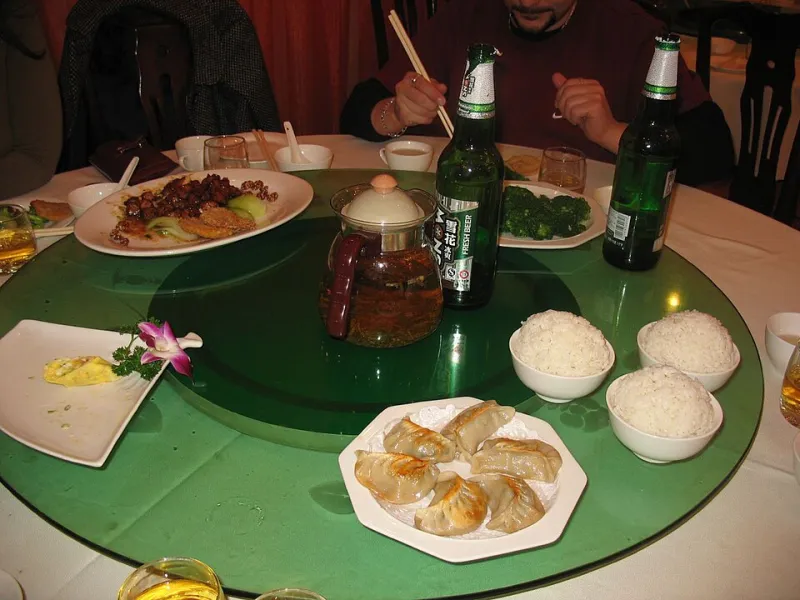
Photo: adifromusa, CC BY-SA 2.0, via Wikimedia Commons
Somewhere between the third glass of Pinot Grigio and the debate about whether the narrator was unreliable or just tedious, someone knocks a vol-au-vent onto the carpet. This is the British dinner party. We have all agreed, without ever discussing it, that the correct way to feed twelve people is to balance paper plates on our knees and eat miniature sausages with toothpicks.
It doesn't have to be this way. There is an older, wiser system, refined over centuries and available from your local Chinese restaurant for roughly what you'd spend on a mediocre cheese board: the shared banquet. And at the centre of it, slowly revolving like a scholarly meditation, sits the greatest hosting invention known to humankind — the lazy Susan.
The Maths of the Table
Before you ring anyone, learn the golden ratio: one dish per head, plus one for the table. Six people? Seven dishes. Eight people? Nine. This isn't superstition; it's balance. The extra dish gives the meal breathing room and ensures nobody hovers anxiously over the last piece of aubergine.
Now divide those dishes properly. A well-ordered banquet table needs:
- A centrepiece protein — a whole fish, crispy aromatic duck, or a braised pork belly that makes people go quiet
- Two or three vegetable dishes — greens with garlic, aubergine in black bean sauce, dry-fried green beans. These are not afterthoughts; they are the dishes people fight over
- Something saucy — mapo tofu or a claypot, because rice without sauce is a punishment
- A carbohydrate anchor — noodles or fried rice, ordered one per four people, arriving near the end
- One wildcard — something nobody at your book club has tried. Jellyfish salad if you're brave, salt and pepper squid if you're sensible
The mistake British diners make is ordering individually. The banquet is a single composition, not twelve separate meals. You are composing, not catering.
Etiquette of the Revolving Table
The lazy Susan has rules, and breaking them marks you out as a barbarian faster than double-dipping. First: rotate clockwise, gently, and always check nobody is mid-ladle before you spin. Second: take from the dish nearest you, not the one diagonally opposite — the table turns, patience is a virtue. Third: never, ever take the last piece of anything without offering it round first. In Chinese households this is a genuinely competitive sport of polite refusal, and while your book club needn't stage a full dramatic standoff, a murmured "go on, you have it" won't hurt.
If your local restaurant doesn't have a lazy Susan, ask for one. Most will produce one from the back like a magician producing a dove. If they genuinely don't, order dishes family-style anyway and pass things properly. The principle survives the furniture.
Why the Banquet Beats the Buffet
Here is the deeper argument. The British buffet — that sad tableau of quiche, sausage rolls and a bowl of salad nobody touches — is fundamentally antisocial. Everyone builds their own plate, then retreats to a corner with it. Conversation happens in cliques. The buffet is individualism with cocktail sticks.
The shared banquet is the opposite. Every dish belongs to everyone. You must look across the table, time your reach, comment on the food, negotiate. The meal itself forces interaction. There is a reason Chinese business is done over round tables with revolving centres: the geometry is diplomatic. Nobody has a "best seat" because every seat faces every dish.
For a book club — an activity that is 40% reading and 60% looking for an excuse to gather — this is transformative. The food becomes the shared text. "Have you tried the aubergine?" is a far better icebreaker than "so did everyone finish chapter nine?"
The Practicalities, Because You Asked
Ring the restaurant two or three days ahead. Tell them the head count and say the words "banquet set menu" or "family style, we'll order together" — most kitchens will happily steer you. Budget £15–£25 a head depending on ambition and whether anyone orders the whole crab. Ask about dietary requirements in advance; Chinese kitchens are generally excellent at adapting, and there is always tofu.
Book a table, not a buffet. Arrive hungry and slightly early. Order the tea. And when the lazy Susan starts turning and twelve people reach, pause and share, you'll wonder why you ever owned paper plates.
The book was probably fine. The banquet will be better.