The Greenest Thing on the Menu: How One Vegetable Dish Fixes Your Entire Chinese Takeaway
There's a moment familiar to anyone who's ever unpacked a Chinese takeaway on the sofa: the moment you realise everything on the table is essentially the same colour. Golden. Crispy. Sauce-glossed. Delicious, certainly — but by the third dish, your palate has filed for a break and your body is quietly asking whether any of this grows in soil.
The British Chinese takeaway menu is full of vegetables. Genuinely good ones. And week in, week out, we scroll straight past them to reach the sweet and sour chicken. It's a habit worth breaking, because a single proper vegetable dish doesn't just lighten the meal — it makes everything else on the table taste better.
The Missing Third of the Meal
In China, the structure of a meal is built around this idea. Rice is the anchor; meat dishes are accents, not the event. Vegetable dishes — the su cai — occupy a place of genuine respect, often more so than meat. A plate of greens isn't a concession or an afterthought; it's the dish that brings balance, the one the cook uses to show restraint and skill, because there's nowhere to hide when the main ingredient is a leaf.
Somewhere between Canton and Manchester, that logic got inverted. The British takeaway order became a meat parade with rice as ballast. No wonder the meal feels like a marathon by the halfway point.
What You've Been Missing
Consider what's sitting unloved on the typical menu:
- Stir-fried water spinach with garlic — hollow-stemmed, garlicky, gloriously crunchy. If your local does it, order it immediately.
- Aubergine in yellow bean sauce — soft, savoury, faintly sweet, with a texture that verges on luxurious. Pairs beautifully with plain rice.
- Dry-fried green beans — blistered, smoky, tinged with chilli and preserved vegetable. Arguably more addictive than any meat dish on the menu.
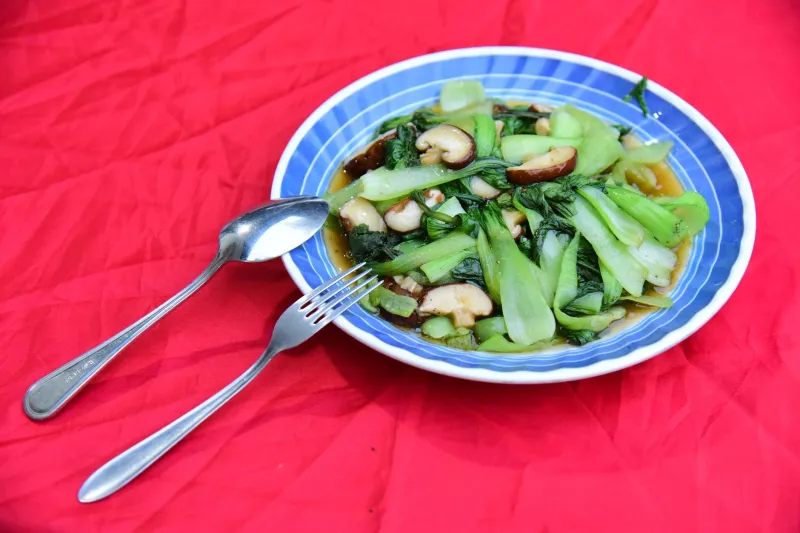
- Stir-fried pak choi or Chinese leaves with oyster sauce — the gateway vegetable dish: mild, glossy, endlessly spoonable over rice.
- Eggplant with garlic and chilli — for when the takeaway leans Sichuanese. Fiery, sharp, brilliant.
How to Order Like You Mean It
A few ground rules. First, one vegetable dish per two people minimum — treat it as non-negotiable, like the rice itself. Second, ask for it less salty or less oily if you like; good kitchens will accommodate, and it lets the vegetable speak. Third, eat it throughout the meal rather than saving it for last. The whole point is contrast: a bite of ribs, then a bite of greens, then back again. It's the palate-cleansing rhythm that makes a Chinese meal sing, and it's why the tenth spring roll never tastes as good as the first.
If you're nervous, start with pak choi in oyster sauce. It's the training wheels option — hard to get wrong, easy to love. From there, work up to the aubergine, then the green beans, and by the time you reach water spinach you'll wonder how you ordered takeaways for years without it.
A Cheaper, Kinder Feast
There's a practical bonus too. Vegetable dishes tend to cost less than their meaty counterparts, so swapping one main for two veg sides often brings the bill down while making the table more interesting. In an era when a takeaway can quietly approach thirty quid for two, that's no small thing.
And there's something fitting in it, too. Our name — the Fragrant Study — nods to the old Chinese scholars who prized simplicity on the plate: rice, greens, a pot of tea, and good conversation. They understood that a meal, like an essay, needs breathing space between the rich passages.
So next Friday, when the app opens and your thumb drifts towards the usual, pause. Add one green thing. Just one. Your chipped plates — and your Wednesday-morning self — will thank you.